

Key Takeaways
- Strong earnings growth offset multiple compression as the S&P 500 rose 2.0%
- The bear market in bonds continues
- The Fed raises rates under new leadership
- Continuity sees opportunity in both markets: earnings growth for stocks and higher starting yields for bonds.
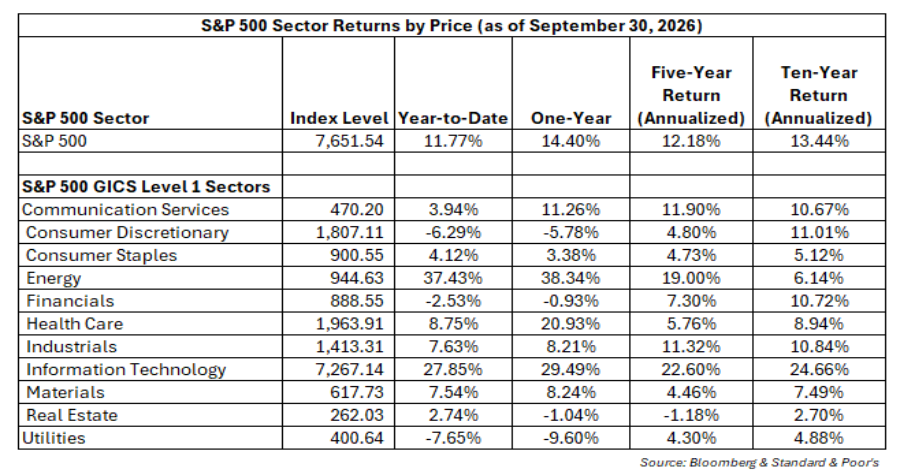
The S&P 500 edged 2.0% higher in the third quarter, but performance beneath the surface was uneven. Only four of the eleven GICS sectors rose: energy, information technology, communication services and health care. Leadership within technology also shifted. Many semiconductor stocks that led earlier in the year pulled back, while previous laggards or underperformers, including Microsoft, Meta Platforms, NVIDIA and Apple, outperformed during the quarter.
Despite muted index volatility, performance diverged meaningfully in the S&P 500. Retailers, regional banks, and transportation companies, along with many semiconductor stocks, experienced pullbacks. Even so, the S&P 500 held steady, illustrating why diversification can help portfolios remain resilient when leadership shifts abruptly.
Many of the quarter’s most significant moves occurred outside equities. Geopolitical developments continued to drive volatility in energy markets. West Texas Intermediate Crude rose 30.1% during the quarter after falling 31.4% in the second quarter and is now up 57.5% for the year. Energy was the best-performing sector, rising 16.5% as commodity prices climbed.
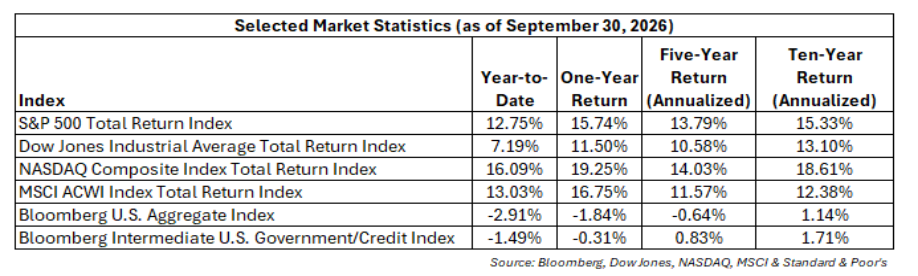
Bonds, meanwhile, remained in a bear market. The Bloomberg U.S. Aggregate Index (“the Agg”) fell 3.51% in the quarter and is now down 2.91% through September 30th.
International stocks were little changed during the quarter. The MSCI EAFE Index gained 0.3%, while the MSCI Emerging Markets Index declined 1.0%. Emerging-market equities have outperformed the S&P 500 through September, while developed-market stocks have lagged slightly. Sector composition helps explain the difference: information technology represents approximately 41% of the MSCI Emerging Markets Index but only 10% of the MSCI EAFE Index (source: MSCI).
A New Fed and Rising Interest Rates
The transition from Jerome Powell to Kevin Warsh may prove to be the Federal Reserve’s most consequential leadership change since Paul Volcker became Chair in August 1979. Warsh has advocated reducing the Fed’s prominence in financial markets by limiting forward guidance, shrinking its balance sheet, modernizing its data analysis and allowing market signals to play a larger role in policy. We agree with the direction of these reforms: the Federal Reserve should respond to economic and market conditions rather than attempt to lead them.
The FOMC voted unanimously to raise the federal funds rate target range by a quarter point on September 16th to 3.75% to 4.00%. Treasury yields rose across the curve in the third quarter. The five-year Treasury yield reached 5.10% on September 29th, its highest level since July 2007 (source: Bloomberg). This led to losses for investors in most broad, investment-grade indices in the United States.
Several factors may have contributed to the recent rise in rates, including geopolitical instability, higher oil prices, persistent service-sector inflation, AI-related investment and borrowing needs, the federal budget deficit and higher global yields. The resilience of the U.S. economy should not be minimized. Nominal GDP grew 6.3% year over year in the second quarter according to the Bureau of Economic Analysis. Stronger nominal growth, whether generated by inflation, real GDP growth or both, would ordinarily be expected to place upward pressure on interest rates.
We generally maintain conservative bond positioning with respect to interest-rate sensitivity. The Agg’s current duration is around 5.7 years. Unless a client has a specific mandate, we try to target durations closer to three years, accepting modestly more credit risk than the index. This positioning seeks to limit sensitivity to further rate increases while preserving meaningful income potential.
Strong Economy is a Tailwind for Stocks
While rising rates were a headwind for bonds, they did not cause a decline in the S&P 500. The growing economy led to robust earnings growth. The strong increase in earnings more than offset price-to-earnings multiple compression that was at least partially due to rising rates.
The gains were not uniform. Large capitalization companies generally have better balance sheets and more fixed-coupon debt than smaller companies. They are better able to manage rising interest rates. This showed in the quarter’s results: the Russell 2000 Index fell 7.5% while the S&P 500 rose 2.0%.
The third quarter brought a reversal in the relative fortunes of AI spenders and AI enablers. Semiconductor manufacturers and certain industrial companies led the market through much of the first half of 2026, while hyperscalers such as Microsoft and Meta Platforms lagged. That pattern reversed as valuations of the earlier leaders became stretched, Microsoft reported solid earnings and Meta released its Muse AI agent. The Philadelphia Semiconductor Index peaked on June 22nd and ended the quarter 13.8% below that level despite NVIDIA’s recent rally. The quarter-end figure understates the severity of the interim correction: the index fell 28.7% in just over a month, bottoming on July 29th before recovering into quarter-end (source: Bloomberg).
Stay Invested and Nimble
The pre-earnings quiet period between now and the second week of October often brings modest equity volatility. The midterm elections are another potential source of turbulence, and the rise in interest rates may not yet be exhausted. Stocks often need time to absorb rate increases, but the adjustment should remain manageable if the Fed avoids overtightening. These risks do not make us bearish because earnings continue to grow rapidly. Year-over-year comparisons for third-quarter earnings set a high bar, yet low jobless claims and strong PMIs remain supportive. We therefore expect positive market performance to remain possible even if valuation multiples continue to compress.
For bonds, starting yield-to-maturity is one of the best predictors of long-term returns. We believe this is an attractive environment for bond investors who maintain relatively low duration. Yields exceed 5% on intermediate Treasuries and are near 6% in investment-grade debt. Risks remain across financial markets, including inflation, geopolitical conflict and uncertainty surrounding AI investment. Even so, patient fixed-income investors can take comfort that prospective returns have improved since the beginning of the year. Meanwhile, equity investors continue to benefit from earnings growth that can offset further price-to-earnings multiple compression. The appropriate balance between these opportunities varies from client to client. Please reach out to us if you have any questions or concerns.